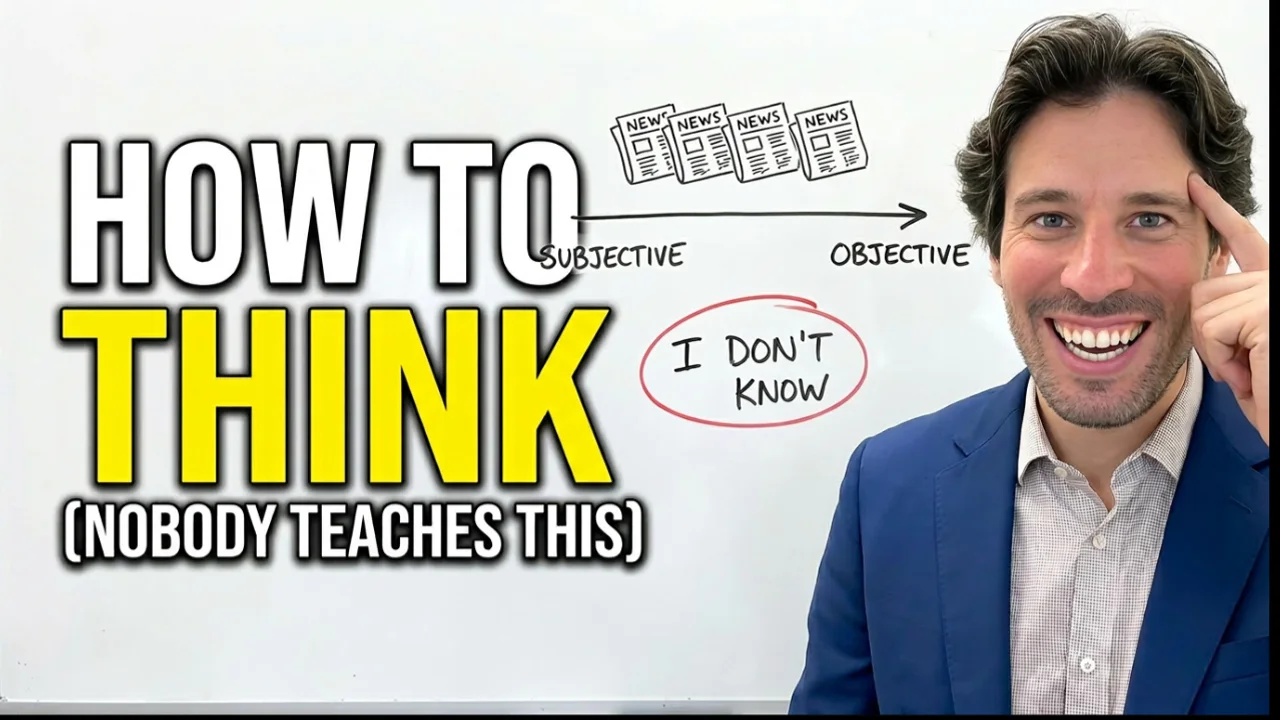
Media manipulation shapes emotions by curating facts and timing, not by lying outright.
You might also like




TL;DR: Media manipulation shapes emotional responses by controlling what you see, in what sequence, and through which frame — not by feeding you false facts. Selective framing and repetition trigger fear, anger, or sympathy before your rational analysis has a chance to catch up. The antidote is a three-step practice — silence first, humility second, "I don't know" third — that creates the gap between stimulus and honest evaluation. Charles estimates the Pareto ratio has compressed from 80/20 to roughly 95/5 in the social media era, meaning focused, clear thinking carries more leverage now than ever. Creation is the structural escape from consumption and distraction. None of this is a personality trait; it is a repeatable sequence anyone can run.
What is media manipulation?
Media manipulation is the systematic shaping of emotional responses through selective framing, sequencing, and repetition of information, without necessarily presenting false facts. I walked past a newsstand in 2011 and counted 8 or 9 national newspapers all running the same story — different headlines, different camera angles on the same photo, one making the subject look heroic, another making them look threatening. Nothing was technically false. The selection was everything. That is how manipulation works: not through lies, but through the frame you never notice you absorbed.
The environment rewards this approach at every layer. Social platforms surface content that generates the most engagement, and anger, fear, and outrage reliably produce more clicks, shares, and watch time than measured analysis — so that is what the algorithm promotes. Cable news discovered decades ago that emotionally charged stories keep viewers watching longer than neutral ones, which is why the urgent lower-third crawl never really goes away. Headlines written to provoke a strong reaction before the reader reaches the second paragraph consistently outperform factual ones on click-through rate. None of this requires a conspiracy. It is just incentive following incentive: the audience reacts more to heat than to light, so the system produces heat. Understanding that structural reward is what makes the silence-first framework necessary rather than merely useful.
What is the core framework for thinking objectively?
Why do algorithms amplify manipulation rather than correct for it? Algorithms optimize for the metric they are given, and the metrics social platforms use — watch time, shares, comments, reactions — all correlate more strongly with emotional intensity than with informational accuracy. A post that makes you angry keeps you on the platform longer than a post that accurately informs you and sends you away to act on what you learned. That structural incentive means the algorithm is not neutral: it consistently surfaces content that provokes a reaction over content that informs a decision. Charles's point is not that the engineers who built these systems intended to amplify manipulation — the incentive structure produces that outcome regardless of intent. Which is why the solution is not to wait for the platform to fix the problem. The solution is to change your own relationship to the feed: less consumption, more creation, silence before engagement.

0 Comments
Log in to comment
Not a member yet? Join the community
Pick a meme
KlipyHave a great take?
Drop your email — we'll send a magic link so you can post it. No password.
Not a member of the community? Join today.
Join the community →