Why is AI-generated content making authentic human creativity more valuable right now?
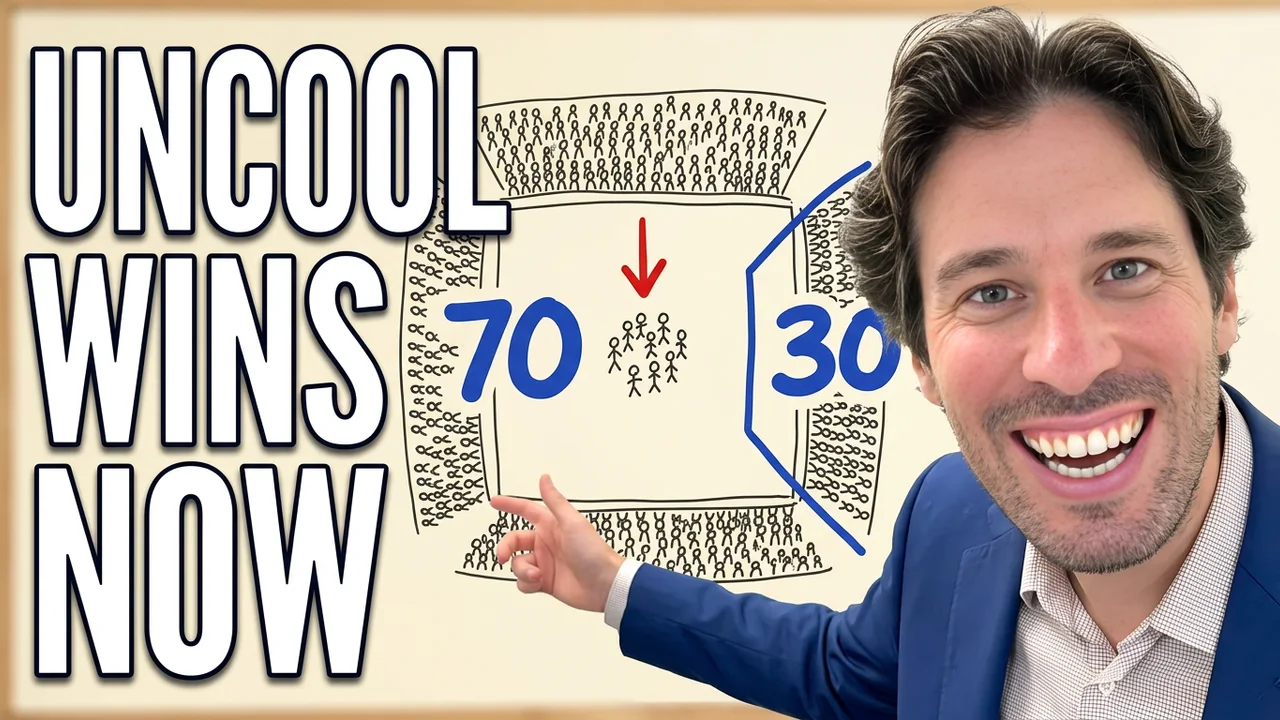
Authentic content in the AI era is content that costs something — time, risk, public exposure — and carries a traceable human fingerprint that machine output cannot replicate. By my own estimate — not a cited study, but a read I've developed across 330 days on camera watching audience behavior, feed patterns, and what actually gets built versus consumed — roughly 5% of people are actively creating right now, and the other 95% are consuming and watching. As AI content scales, the gap between machine-perfect and human-real becomes the most valuable creative asset a person can own. That's what my writing on AI and authenticity has been working toward. This whiteboard session brought it into focus.
The pressure is already visible. I'm in New York City watching people scroll constantly. They build no real personality. They just chase whatever trend feels safe. That's the 95% in the stands — my estimate, drawn from years of direct observation and watching what gets made versus what gets watched, not a published survey. The 5% on the field are the ones creating, failing publicly, and building something real.
To make this concrete: here's how AI-generated content and human-authentic content actually differ in practice.
| AI-generated content | Human-authentic content |
|---|---|
| Consistent tone, no stumbles | Variable tone, visible effort |
| Optimized for search intent | Built around genuine curiosity |
| No personal history or stakes | Traceable back to a real person's choices |
| Scales infinitely at zero marginal cost | Costs something — time, risk, exposure |
| Trend-responsive by design | Idiosyncratic by nature |
That table is why I think the shift is structural, not cyclical. The two modes compete on entirely different dimensions.
Why do I use a 70/30 ratio of inspirational to raw content?
This ratio came from watching what actually connects in my own feed over the past year. It's my own framework, not a formula from a study. My target is 70% inspirational — content that gives people something to aim at — and 30% raw. The raw 30% is where things went wrong, where I didn't know the answer, where I was just human. Some weeks I push it toward 75/25, because higher standards are the aim. But the 30% is non-negotiable.
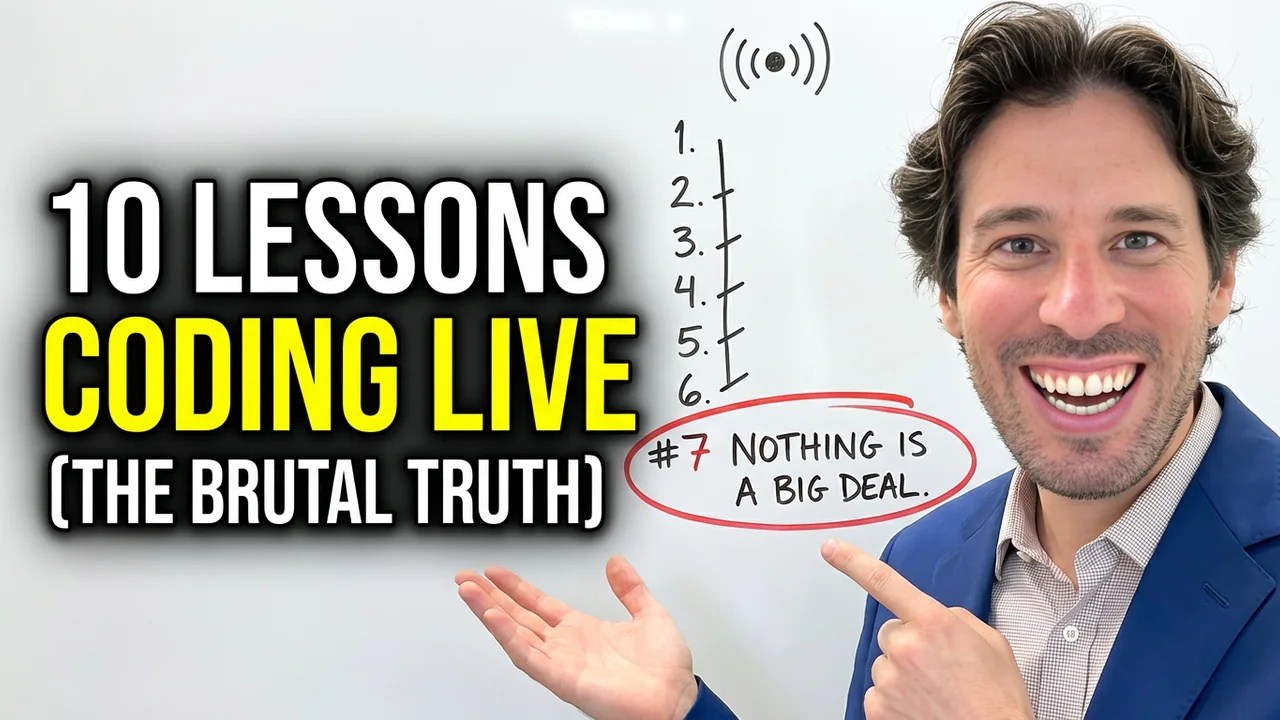
At [0:00] I said: "for every seven pieces of content you mix in three that are like hey listen i just had a floible or i just did something that's silly i can't believe this" — that ratio isn't a content hack. It's a trust-building structure I arrived at through trial and error.
The pickles example is the one I keep coming back to. Five years ago my brother told me pickles are made from cucumbers and I had no idea. Everyone laughed. That moment of real ignorance, shared openly, connects more than any polished reel. The person who admits they didn't know something is the person people follow. They believe the other 70% more because of it.
You might also like
How does showing imperfection publicly actually build confidence and trust?
This is the counterintuitive part. Most people assume that showing weakness erodes authority. My experience is the opposite. When I'm vulnerable — in brainstorming sessions, in these whiteboard videos, in the live vibe-coding streams — that's when the biggest breakthroughs happen. Being okay with being the center of an imperfection is what confidence looks like from the outside.
Here are the ways I've shown authentic imperfection across 330 days of content — not as a strategy, but as a record of what happened:
- Admitting I didn't know pickles came from cucumbers, on camera, without editing it out
- Going live 42 times building software with no traditional dev background and saying so every session
- Leaving Day 26 up — the breakdown stream — instead of deleting it
- Pivoting from self-development to faith to vibe coding publicly, without explaining myself in advance
- Running brainstorming sessions where I arrive at the wrong answer and correct it mid-video
I've gone live 42 times doing vibe coding. I know almost nothing about traditional software development. I said so every session. People don't follow the expertise — they follow the honesty about the gap between where I am and where I'm going.
Brené Brown's foundational research on vulnerability as a driver of human connection maps directly onto what I'm seeing in my own numbers. The mechanism is the same: perceived risk of exposure, taken anyway, creates trust.
Why did I keep my Day 26 breakdown stream public instead of deleting it?
Day 26 was a breakdown. I was unwell. The last 20 minutes of that stream were not good. I left it up. That was a deliberate call. It's probably the clearest example of the 70/30 philosophy I've put into practice. Deleting it would have been the polished move. Leaving it was the authentic one.
I'm not recommending public breakdowns as a content strategy. What I'm saying is this: when it happened, choosing to leave it up was consistent with everything I'd been arguing on the whiteboard. The 30% only works if it's real. Staged vulnerability is just a different kind of polish.
Why aren't most people creating yet — and how is AI about to force the issue?
No — and that's the problem AI is about to force. Based on my own sustained observation across 330 days of content creation and watching what people actually do with their time, I'd put it at roughly 5% of people actively creating and 95% consuming and watching — that's my personal read from direct experience, not a published figure. AI is going to compress that. As automation takes more jobs and robotics enter more spaces, people will need to build something that's theirs — content, a business, a craft — something with a human fingerprint on it.
The Pew Research data on screen time and social behavior shows how deeply passive consumption has become the default, especially for younger people. I see it at every party I go to in New York. No one is building a personality. They're borrowing one from whatever trend feels safe that week.
The arena metaphor I drew on the whiteboard captures it: stands full, field nearly empty. AI isn't going to let that ratio hold. It's going to push people onto the field whether they feel ready or not.
What does it look like to publicly pivot your content direction multiple times?
My own channel is a case study in the messy version of this. I've run three completely different directions on YouTube:
- Self-development content — the first phase, built around personal growth frameworks.
- Faith content — a pivot that surprised people who'd followed the first phase.
- Vibe coding — 42 live sessions building software in public with no traditional dev background.
None of those transitions were clean. Each one required saying publicly: I'm going somewhere new and I don't know exactly where it lands. The next move is probably combining all three — not as separate channels, but as one person. People following Charles, not a content category.
That's the long-term bet. A category can be replaced by AI. A person — with their specific quirks, wrong turns, and genuine curiosity — is much harder to replicate.
How can you hold yourself to high standards while embracing authentic imperfection?
These two things sound like they contradict each other. They don't. High standards and authentic imperfection work on different axes. Standards are about what you're aiming at — how you dress, what you put in your body, the quality of your thinking, your decorum. Imperfection is about being honest when you fall short of those standards.
AI has extremely high standards in reasoning and logic. That's part of why it feels disorienting. The answer isn't to lower human standards. It's to raise them while being honest about the gap. The cathedrals in Europe, the murals, the sculptures — that's human beauty built to an elite standard, with every imperfect chisel mark still visible.
The goal I'm working toward: 70% or better on the inspiration side, with the 30% being genuinely unfiltered rather than performed. That's a harder target than it sounds.
What questions do creators most have about building an authentic content strategy?
Does this approach work for every type of content creator, or only certain niches? From what I've observed across 330 days and across wildly different content directions — self-development, faith, vibe coding — the underlying dynamic holds regardless of niche. Trust is trust. The 70/30 structure isn't about a topic, it's about a relationship with an audience. The specific flavor of raw content changes: a fitness creator's 30% looks different from a coder's 30%. But the mechanism — high-aspiration content grounded by honest imperfection — appears to work wherever a human is trying to build a real following rather than a trend-chasing account.
0 Comments
Log in to comment
Not a member yet? Join the community
Pick a meme
KlipyHave a great take?
Drop your email — we'll send a magic link so you can post it. No password.
Not a member of the community? Join today.
Join the community →