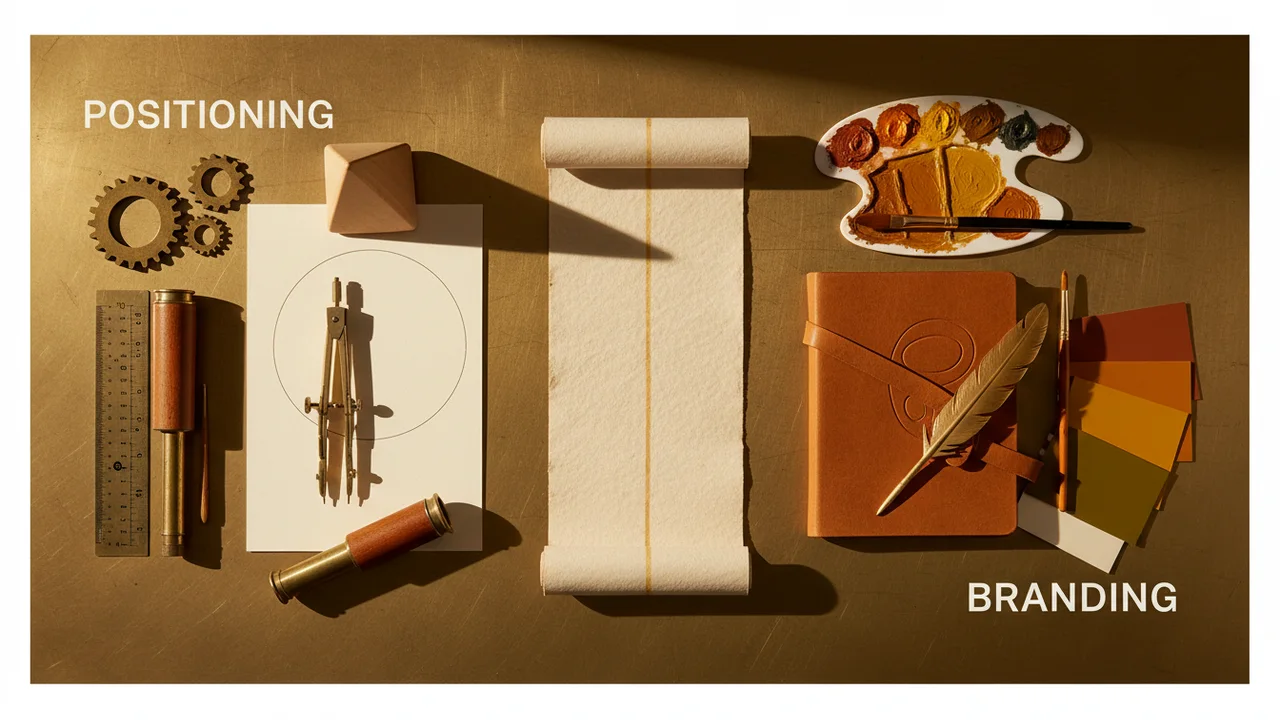
Positioning and branding are two different jobs. Positioning is the strategic choice of what category you compete in and why you win it — the concept Al Ries and Jack Trout named in their 1981 book Positioning. Branding is how that choice looks and sounds: name, logo, voice, colors. Positioning is the argument; branding is the expression. Positioning comes first. Get the order wrong and you decorate a claim nobody understands.
What is positioning, exactly?
Positioning is the deliberate choice of the market category you compete in and the reason a specific customer should pick you over the alternatives. It is a strategy decision, not a design task.
Al Ries and Jack Trout framed positioning in 1981 as a battle for a place in the customer's mind. Decades later, April Dunford's positioning framework in Obviously Awesome made it operational: your product's competitive alternatives, your unique attributes, the value those attributes create for a target segment, and the market category that makes that value obvious.
Good positioning is specific enough to exclude people. "Project management for construction crews" positions; "software for teams" does not. If your positioning could belong to a competitor without changing a word, you don't have positioning — you have a description.
What is branding, exactly?
Branding is the identity and expression that make your positioning recognizable and repeatable — the name, logo, colors, typography, tone of voice, and the emotional association people carry after they interact with you. It is what a customer sees, hears, and feels.
Branding also covers messaging: the words on the page. Donald Miller's StoryBrand framework is a branding tool — it structures how you talk about the customer's problem and your solution. Interbrand's Best Global Brands report has ranked Apple the world's most valuable brand for over a decade, and that ranking measures brand equity: recognition and trust built on top of a clear position.
You might also like
Branding without positioning is decoration. A beautiful logo on a product nobody can categorize still loses, because trust needs something to attach to.
Positioning vs branding: how are they different?
Positioning is the decision; branding is the delivery. Positioning defines the claim, and branding makes that claim recognizable, consistent, and emotionally sticky.
| Dimension | Positioning | Branding |
|---|---|---|
| Question it answers | Why should they choose us? | What do they recognize and feel? |
| Nature | Strategy | Expression |
| Primary output | A market frame and a claim | Name, logo, voice, colors |
| How often it changes | Rarely — it's a big bet | Often — refreshes and updates |
| Who usually owns it | Founder or strategy lead | Design and marketing |
| Fails when it's... | Vague or generic | Polished but empty |
The table shows the trap: teams treat branding tasks as strategy. Picking a color is not deciding who you're for. Naming the product is not choosing the category you'll fight to own.
Why does positioning have to come first?
Positioning comes first because it tells branding what to say. Every branding decision — name, tagline, homepage headline, color mood — is an answer to a question positioning defines: who is this for, and why is it the obvious choice?
Skip positioning and branding has no brief. You end up with three predictable symptoms:
- A pretty homepage that doesn't convert, because visitors can't tell what category you're in.
- Endless internal debate about copy, because there's no agreed claim to express.
- Expensive rebrands that change the paint but not the underlying confusion.
Fix positioning and most branding questions answer themselves. The headline writes itself once you know the category and the customer.
How we build positioning before branding at Botensten
We ship production software with AI every day, and we keep relearning this the hard way: the logo is the tempting first move, and it's the wrong one. On one internal tool last quarter, we spent two days on a name and a color system before we could explain in one sentence who it was for. Early users bounced. The brand looked clean; the position was missing.
So we changed the order. Now, before anyone opens Figma, we write a one-page positioning doc: competitive alternative, unique attributes, the value for a named segment, and the category. It takes an afternoon and a shared doc — near zero cost.
The economics are blunt. A rebrand can burn thousands of dollars in design and weeks of calendar time. A positioning rewrite costs an afternoon. When we got positioning right first, the branding pass got faster, because the headline, the feature order, and the tone were already decided by the strategy. We build this way because renting someone else's vague category is how you stay invisible — and owning a sharp position is the cheapest growth lever a solo operator has.
Which one should you fix first?
Fix positioning first — almost always. If customers can't explain what you do or why you're different, no amount of branding polish will save you. Branding amplifies a clear position; it cannot rescue a muddy one.
Run this quick check before spending a dollar on design:
- Can a stranger repeat your category back to you in one sentence? If not, positioning.
- Do two customers describe you the same way? If not, positioning.
- Is your product recognizable but under-loved? That's a branding job.
- Are conversions low despite good traffic? Usually positioning, sometimes messaging.
The honest sequence: nail positioning, express it through branding, then let branding compound recognition over time. Position first, or the market positions you.
0 Comments
Log in to comment
Not a member yet? Join the community
Pick a meme
KlipyHave a great take?
Drop your email — we'll send a magic link so you can post it. No password.
Not a member of the community? Join today.
Join the community →