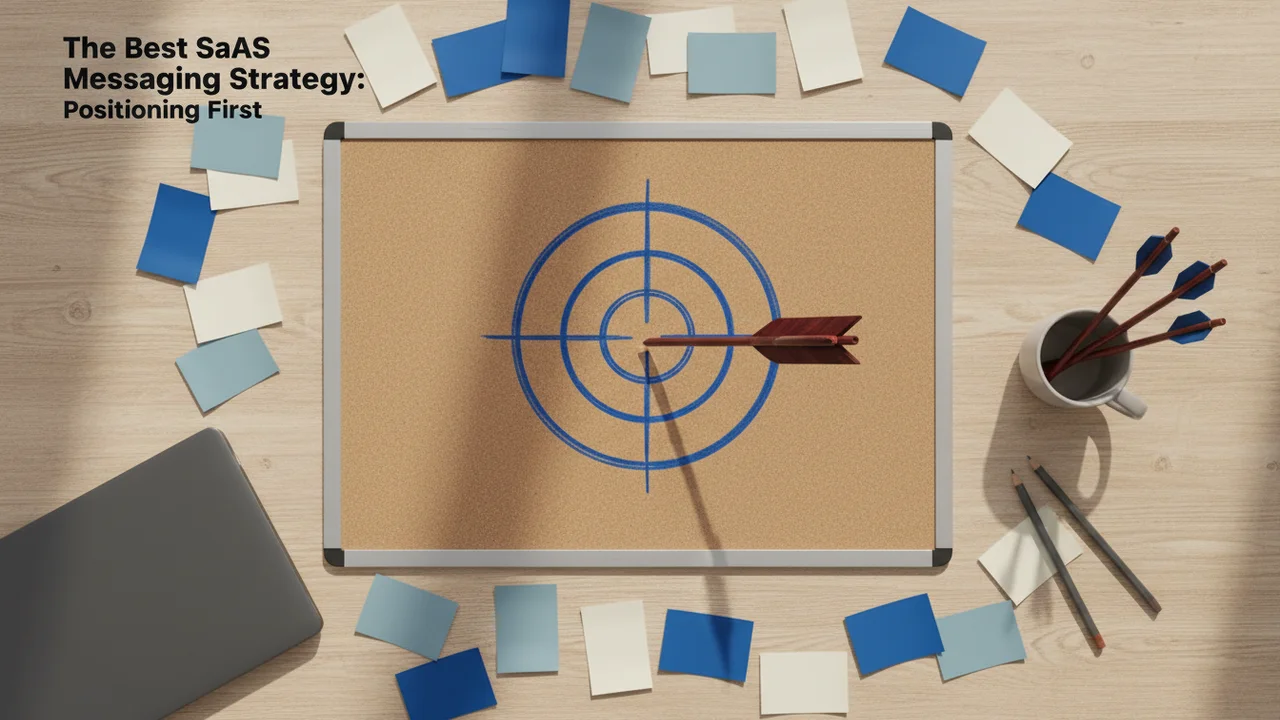
The strongest SaaS messaging starts with positioning, a discipline April Dunford maps in Obviously Awesome: pick one specific customer, name the alternative they'd use instead, and state the single outcome you deliver better than that alternative. Prospects decide in about five seconds whether a headline is for them, so lead with the job they hire your product to do — not a feature list.
What Makes SaaS Messaging Actually Work?
Good SaaS messaging makes a stranger think "this is for me and I get it" within one screen. It fails when it lists features, hedges to appeal to everyone, or hides the outcome behind jargon.
Three things carry the weight:
- Specificity. Name the exact person and their exact problem. "Invoicing for freelance designers" beats "billing software for teams."
- Contrast. Say what you replace. People understand new products by comparing them to the old way.
- Outcome. Promise the change, not the mechanism. Nobody wants a dashboard; they want to stop guessing.
If your headline still makes sense after you paste a competitor's logo on it, it isn't messaging — it's decoration.
Why Does Positioning Come Before Messaging?
Positioning comes before messaging because messaging is positioning written in sentences. Decide who you serve and what you displace first; the words are downstream of those decisions.
April Dunford's Obviously Awesome frames positioning as context-setting: you choose the market frame customers judge you inside. The classic argument in Al Ries and Jack Trout's Positioning is similar — you win a spot in the customer's mind by being the clearest option in one category, not the most feature-rich across all of them.
You might also like
Skip this and every downstream asset drifts. Your ads, onboarding, and sales deck each invent their own story, and the prospect feels the seams.
How Do You Write Messaging That Converts?
Write messaging that converts by starting from the customer's own words and one measurable outcome, then cutting everything that isn't that. Turn one clear promise into a headline, subhead, and three proof points — in that order.
A repeatable sequence we use:
- Interview five recent buyers. Ask what they almost bought instead and what finally made them pick you. Their phrasing becomes your copy.
- Write the one-sentence promise. "[Product] helps [specific customer] [achieve outcome] without [the pain of the old way]."
- Draft the headline from that promise. Keep it under twelve words and free of adjectives like "powerful" or "seamless."
- Add three proof points. A number, a named integration, a recognizable customer — concrete beats clever.
- Run the five-second test. Show it to someone cold; if they can't say what it does, rewrite it.
The Jobs to Be Done framework in Harvard Business Review is the fastest way to find outcome language — it forces you to describe the progress a customer is trying to make.
What Messaging Framework Should You Use?
Use the framework that matches your bottleneck: StoryBrand for a confusing narrative, Obviously Awesome for an unclear category, and Jobs to Be Done for weak outcome language. Most SaaS teams need positioning clarity first, then a narrative wrapper.
| Framework | Best for | Core question | Weak spot |
|---|---|---|---|
| Obviously Awesome (Dunford) | Unclear category or crowded market | "What are we an alternative to?" | Light on emotional narrative |
| Building a StoryBrand (Miller) | Muddled homepage story | "Who is the hero and the guide?" | Can feel formulaic if overused |
| Jobs to Be Done | Feature-led, outcome-poor copy | "What progress is the customer making?" | Needs real customer research |
| Positioning (Ries & Trout) | Losing a category fight | "What word do we own?" | Predates SaaS self-serve funnels |
Donald Miller's StoryBrand framework is useful because it casts the customer as the hero and your product as the guide — a quick fix for founders who make themselves the star of their own homepage.
How We Rewrote Our Own Product Messaging
We rewrote our own headline three times before it worked, and each rewrite came from a customer sentence, not a brainstorm. Our first version led with the tech ("AI-native build platform"), and cold readers had no idea what changed for them.
The trade-off that bit us: we optimized for how impressive we sounded instead of how fast a founder understood us. In build-in-public terms, that meant demo signups but few activations — people arrived curious and left unsure.
What we changed was concrete. We swapped the feature headline for an outcome-and-alternative line: own the software your business runs on instead of renting it. We named the old way — paying monthly for tools you'll never control — because contrast did more work than any adjective.
We also cut our feature grid above the fold and replaced it with one promise plus three proof points. Activation from new visitors climbed once the message matched the job people came to do. The lesson we keep relearning: ship the message, watch real behavior, and let the numbers, not taste, pick the winner.
Which Messaging Mistakes Kill SaaS Growth?
The mistakes that quietly kill SaaS growth are vagueness, feature-dumping, and talking to everyone. Each one raises the effort a prospect must spend to understand you, and effort is where funnels leak.
Watch for these:
- Adjective soup. "Powerful, intuitive, seamless" says nothing checkable. Replace it with a number or a named example.
- Being your own hero. If your copy brags about your team instead of the customer's outcome, flip it.
- No named alternative. Without contrast, prospects can't place you, so they default to doing nothing.
- One message for all segments. A page that fits enterprise and solo founders equally fits neither.
- Changing the message everywhere but the product. Onboarding must deliver the promise the headline made, or churn follows.
Fix the message once at the positioning layer and the whole funnel — ads, landing page, onboarding — starts telling one story.
0 Comments
Log in to comment
Not a member yet? Join the community
Pick a meme
KlipyHave a great take?
Drop your email — we'll send a magic link so you can post it. No password.
Not a member of the community? Join today.
Join the community →