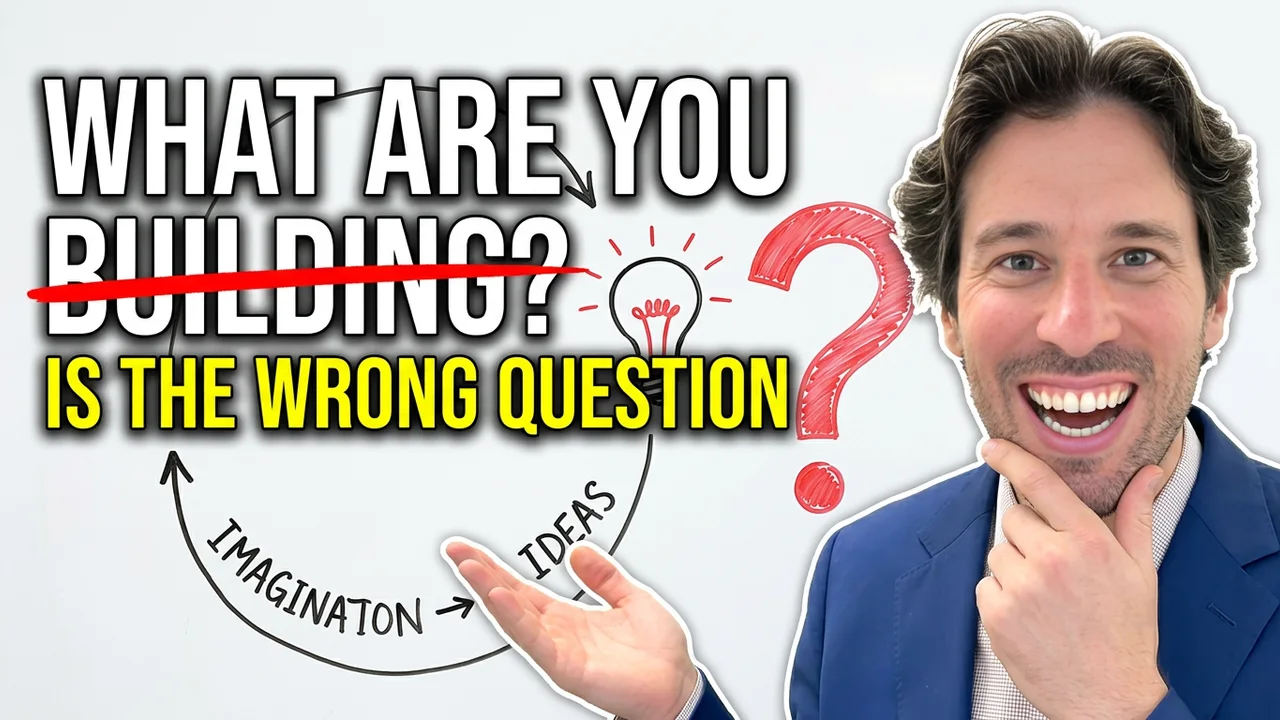
Why does "what are you building?" produce the wrong answer?
The most important question a founder can ask before pitching is not "what are you building?" — it's "what problem do I care deeply enough about to sit with in silence?" Stating your product label too early forecloses curiosity, kills imagination, and leaves you building something shaped by a name instead of a real need. Resisting that reflex is the discipline that separates builders who find real problems from those who find product categories. On Day 307 of my live vibe-coding run, I keep getting the former in chat — someone joins, sees the stream, and immediately types it. My instinct is never to answer directly. Not because I'm hiding something. Because the moment I hand you the label, your brain stops working on the problem.
A fan is a fan. But "something that cools you down when it gets really hot" — that you can feel. The difference is whether your imagination gets to run first.
At [0:27] I said: "if I say what it is immediately, there's no feelings invoked. There's no curiosity invoked. I told you what it is" — and that's the whole trap. A direct answer trades a moment of clarity for every idea the listener might have generated on their own.
What is the circular loop between imagination and ideas?
The curiosity-imagination loop is the self-reinforcing cycle through which builders generate better ideas: curiosity opens a question, imagination generates possibilities, and each idea produces new questions that deepen curiosity. The loop only spins when four conditions are present:
- Silence — resisting the reflex to label or pitch before you understand the problem
- Humility — treating each signal as a reason to ask another question rather than confirming what you already believe
- Willingness to fail — letting first-principles thinking lead even when it produces wrong turns. First-principles thinking is the discipline of stripping a problem to its irreducible components — breaking it down to what is actually, undeniably true — before building your solution back up from scratch rather than from inherited assumptions.
- High-quality questions — structuring inquiry around lived problems, not hypothetical solutions
Each one feeds the others. Remove any single condition and the loop stalls.
Imagination and ideas form a circular loop — each one feeds the other, and the only way to enter the loop is through curiosity. I've said this before on stream: you have to sit in silence. You have to be willing to say "I don't know what this is yet" before you can figure out what it should become.
That sounds passive. It isn't. Sitting in silence is an active choice to resist the reflex of labeling things too early. Most builders skip it entirely. They get a concept, name it, pitch it, and then wonder why the product feels hollow six months in.
The loop only spins when humility is present. Arrogance closes it. If you already know what you're building, you stop asking questions — and questions are the only engine that matters.
How did watching Matt Miller's MRR plateau change my 180-day plan?
Matt Miller — the builder behind BridgeMind — talked openly about his monthly recurring revenue stagnating. He'd been growing, then it flattened, then it started sliding. By Charles's account, he's up roughly $17,000 since that conversation, with new memberships coming in and strong marketing execution. I'm not taking anything away from him. I actually like listening to him because my imagination starts moving when I hear his problems.
What I did was put myself in his shoes. I said: in 180 days, that plateau is probably going to be me. Not his exact MRR number — but the same structural problem. Growth, then stagnation, then the question of what to do next.
That observation sent me back to silence. Then to a whiteboard. Then to a real planning session. The 180-day horizon isn't a goal — it's a threat I'm preparing for now, while I still have runway to think clearly.
You might also like




What does first-principles thinking actually look like in practice?
First-principles thinking is the discipline of stripping a problem back to its irreducible components before building back up. Elon Musk is the example I keep returning to. He didn't ask "how do I build a better car?" He asked what a car actually needs to be — and found that most of it was unnecessary weight, complexity, and legacy assumptions.
The battery overheats. Fine — why does it need to be that heavy? The engine has hundreds of moving parts. Fine — why does it need any of them? You end up with more storage, a cleaner design, and a product that couldn't have existed if you'd started from the existing template.
He failed a lot to get there. That's not incidental — it's the mechanism. Humility under failure is what keeps the first-principles loop honest. Without the willingness to be wrong, you just rationalize the existing design.
Why are high-quality questions better than confident statements?
Tony Robbins said it years ago, and I pushed back on it at the time: the salesperson who asks the most high-quality questions wins. My instinct was that statements — facts, confidence, authority — were what closed deals. I was wrong.
At [5:12] I said: "high quality questions formed correctly, changed my life. It literally changed my life" — and I mean that without exaggeration. The questions I started asking about my own product, my own community, my own content strategy produced pivots I never would have reached through assertion alone.
The real estate framing is the clearest version: Is there a timeline you're looking to sell by? Is there a price range? Are there other decision makers I should be talking to? Those aren't small-talk. They're the structure of understanding someone's actual problem before you try to solve it. Curious people ask questions. They're willing to sit in the answer and feel uncomfortable before they move.
What pivots did curiosity actually produce for iCharles?
The planning session that followed my 180-day realization produced 3 concrete pivots. Here's what changed and why:
- Video hosting moved off local storage and onto Cloudflare Stream — a decision driven by reliability and scale, not convenience.
- The product thesis shifted from "the value is the community" to "the value is the community plus the videos" — those are meaningfully different businesses.
- A YouTube content library became a strategic priority for both the iCharles channel and my personal channel — not a nice-to-have, but a structural requirement.
None of these came from someone asking "what are you building?" They came from watching someone else hit a wall, imagining myself hitting the same wall 180 days out, and then sitting with the discomfort long enough to ask real questions.
The pattern is consistent: curiosity → silence → humility → planning → pivot. Skip any step and the output degrades.
What do builders most often get wrong about curiosity and product thinking?
Is curiosity a skill or a personality trait?
It's a practiced discipline, not a fixed trait. I've had to rebuild it deliberately after periods of moving too fast. It atrophies when you stop creating conditions for it — silence, humility, willingness to fail — and it responds to practice like any other skill.
What does "sitting in silence" mean practically?
It means resisting the urge to immediately label or pitch what you're working on. For me it looks like a whiteboard session with no agenda — just a problem statement and time. You're not being passive; you're actively choosing not to foreclose the question before you understand it.
Why shouldn't I just explain my product when someone asks?
Because explanation forecloses imagination — yours and theirs. The moment you hand someone a label, they stop generating their own mental model of what the thing could be. A person who figured out what you're building on their own is far more engaged than one who was told.
How do you use someone else's plateau as a planning input?
Watch for the structural problem, not the specific numbers. Matt Miller's MRR plateau wasn't about his revenue figure — it was about what happens when early growth momentum normalizes. I mapped that structure onto my own 180-day horizon and asked: what decisions do I need to make now so I'm not reacting to that problem under pressure?
When does first-principles thinking break down?
When it becomes a reason to ignore what's already working. First principles isn't "ignore all prior art" — it's "understand why each component exists before deciding whether to keep it." The discipline is knowing which assumptions are load-bearing and which are legacy inertia.
How do you know when an idea is ready to be named?
When the name feels like a description rather than a decision. If you're choosing a name to make the idea feel real, you're too early. If the name is just the shortest way to say what you've already understood through silence, you're ready. I've killed ideas by naming them before I understood them — the name became the product instead of the problem becoming the product.
What is the difference between a pitch and a label?
A label tells someone what category to file you in. A pitch invites them into the problem. The fan versus "something that cools you down when it gets really hot" is the same distinction: one closes the conversation, one opens it. Labels are useful after alignment; they're destructive before it.
How do you generate new ideas when you feel stuck?
I look for builders six to twelve months ahead of me and listen for their frustrations — not their successes, their walls. When I hear friction from someone further along, I ask: what would I do differently to avoid that outcome, or recover faster from it? That question almost always produces an idea grounded in a real problem rather than a hypothetical one.
How do you pitch to someone who already has a fixed mental model of your category?
Lead with the problem the category fails to solve, not the category itself. If someone hears "community platform," they file you next to every platform they've already dismissed. But "the problem is that most communities produce content no one saves and conversations no one remembers" — now they're nodding before you've named anything. The mental model softens because you've addressed a failure they already feel.
Should you share your idea early or protect it?
Share the problem early. Protect the solution until you understand it yourself. Rob Fitzpatrick's The Mom Test formalizes this exactly — his framework is built around asking people about problems they've actually lived with, not pitching solutions and measuring reaction. Feedback on a problem is far more useful than feedback on a solution they haven't lived with. People can steal solutions; they can't steal an obsession.
How does humility connect to idea quality over time?
Humility keeps the feedback loop honest. If I'm too attached to an idea I've already named, I filter every signal through "how does this confirm what I already believe?" That's not idea generation — that's idea preservation. The builders who consistently produce things people want are the ones who treat each round of feedback as a reason to ask another question, not as validation to stop asking.
How do you know if a problem is worth building around?
I ask whether I'd still care about it if I knew the product would fail commercially. If yes — if the problem itself is interesting enough to justify the investigation — that's a signal worth following. Rob Fitzpatrick's The Mom Test offers the clearest framework I've found for testing this: describe the problem in plain terms to people who live in that space, and listen for whether they recognize it from their own experience without being prompted. Fitzpatrick's framework treats unprompted recognition as the diagnostic — when people don't light up at the problem description, when you have to explain why it should matter, he argues that's a signal the problem statement is too narrow or too abstract, not that the pitch needs work. The problems I've abandoned fastest were ones I only cared about because I could imagine them monetizing well. The ones I've stuck with are the ones where the friction bothered me personally and I wanted the solution to exist regardless of the business outcome.
What should you do when a pitch isn't landing?
Treat it as a research signal, not a failure to close. When I walk someone through a problem I think is real and they don't feel it, I ask one follow-up: "what does your current setup actually look like for this?" Either the problem is real and they've already built a workaround I hadn't considered — useful product intelligence — or the problem genuinely doesn't exist for them the way I imagined. Both outcomes are worth more than a successful pitch on a problem nobody has.


0 Comments
Log in to comment
Not a member yet? Join the community
Pick a meme
KlipyHave a great take?
Drop your email — we'll send a magic link so you can post it. No password.
Not a member of the community? Join today.
Join the community →