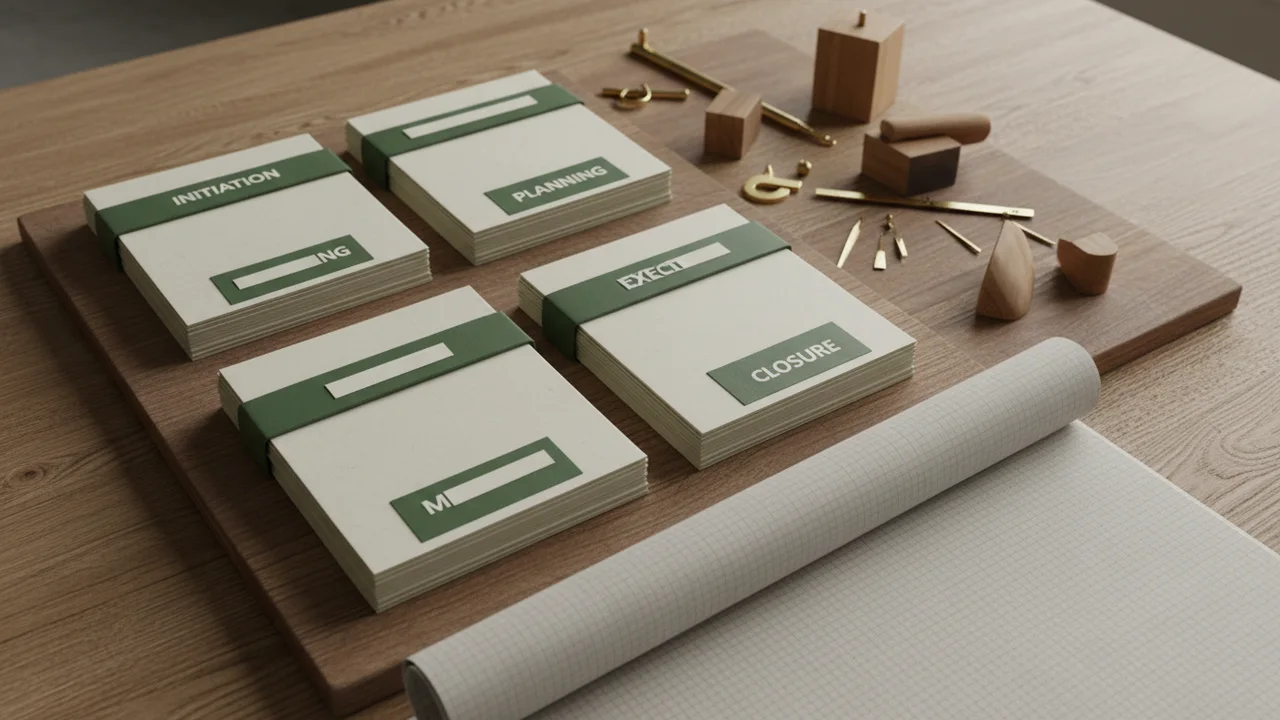
Managing a project from start to finish means moving it through five phases: initiating, planning, executing, monitoring, and closing. These are the five process groups in the PMBOK Guide from the Project Management Institute. Organizations that use formal project management are 75% more likely to meet their goals, according to PMI's 2020 Pulse of the Profession report. Assign one owner, define the goal, then ship in small increments.
What is project management and why does it matter?
Project management is the practice of planning, running, and closing a defined piece of work to hit a specific goal within a set time and budget. It matters because structure changes outcomes. Organizations that apply project management practices are 75% more likely to meet their goals, per PMI's 2020 Pulse of the Profession report.
Success rates are climbing where teams take this seriously. Gartner's 2022 IT Project Success Survey reported that 55% of IT projects were considered successful, up from 44% in 2020. The gap between success and failure is rarely talent. It is whether someone owns the work and whether the goal is written down before anyone starts.
The Standish Group's 2020 CHAOS Report names its top three success factors: user involvement, executive support, and clear business objectives. All three are decisions you make before writing a line of code or a spec.
How do I plan and initiate a project?
Initiate by naming one accountable owner and one measurable goal. Then plan by breaking that goal into scope, milestones, and the resources each milestone needs. The GAO's 2020 Project Management Guide recommends a phased approach with clear milestones and deliverables so progress is visible and checkable.
Use these six steps to go from idea to a plan you can execute:
You might also like
- Write the goal in one sentence, including how you will know it is done.
- Name the single owner who is accountable for the outcome.
- List the deliverables, then cut the ones that are not required for launch.
- Break deliverables into milestones with real dates.
- Map who does each milestone and what they need to start.
- Name the top three risks and one mitigation for each.
Skip the 40-page charter. A one-page plan that a stakeholder can read in two minutes beats a document nobody opens.
What are the key steps in the project management process?
The key steps are the five PMBOK process groups: initiating, planning, executing, monitoring and controlling, and closing. Each phase has a clear exit before the next begins. This is the backbone of how the PMI, the GAO, and most delivery frameworks structure work.
| Phase | Core question | Main output |
|---|---|---|
| Initiating | Should we do this, and who owns it? | Goal statement, named owner |
| Planning | What, when, and with what? | Scope, milestones, resource plan |
| Executing | Are we building it? | Shipped increments |
| Monitoring | Are we on track? | Status against milestones |
| Closing | Did it work, and what did we learn? | Handoff, retrospective |
Most failed projects skip closing. The retrospective is where the next project gets faster, so protect that final phase.
How do I execute and monitor a project the way I actually ship?
I execute by shipping the smallest useful increment first, then measuring against named milestones instead of one far-off deadline. At Botensten we build production software with AI every day, and the pattern that survives contact with reality is: scope down until one person can ship a slice this week, then repeat. Iterative delivery can improve project outcomes by roughly 30%, per the Agile Alliance's Agile Manifesto principles.
Here is what actually broke us. Early on we planned a members feature as one three-week build. It slipped, and we could not tell if we were 20% or 80% done because there were no interim checkpoints. We changed the rule: no milestone longer than five days, and every milestone ends with something a user can touch. When we later shipped a comment system, we cut it into post, then reply, then mentions, then hover cards. Each shipped alone. When mentions broke, only mentions broke.
Monitoring is mostly communication. Effective project managers spend about 90% of their time on communication and stakeholder management, according to a Harvard Business Review 2019 article. A short daily status against milestones catches drift days before a deadline does.
Which project management methodology and tools should I choose?
Choose Waterfall when scope is fixed and known, and Agile, Scrum, or Kanban when requirements will change. There is no universal best method; match the method to how much uncertainty you face. The Scrum Alliance's 2020 State of Scrum report found 70% of organizations using Scrum saw improved team productivity and 61% saw better product quality.
Use this to pick:
- Waterfall — fixed scope, regulated work, clear sequence. Plan fully, then build.
- Scrum — changing scope, a small team, fixed sprints and roles.
- Kanban — steady flow of tasks, few big planning ceremonies, limit work in progress.
For tools, a solo operator does not need enterprise software. A shared board (Trello, Linear, or GitHub Projects), a single source of truth for the plan, and one status channel cover most projects under $0 to $10 a month. Books like Shape Up (fixed time, variable scope) and Making Work Visible are cheaper and more useful than another tool subscription.
How do I handle changes and unexpected issues during a project?
Handle change by comparing every new request against the written goal and current milestones, then explicitly deciding to add, defer, or cut something else. Never silently absorb scope. Uncontrolled scope creep is the most common way on-track projects quietly fail.
Run changes through three questions:
- Does this move us toward the goal, or is it a nice-to-have?
- What comes out to make room, and who agrees to that trade?
- Which milestone shifts as a result, and who needs to know today?
Agile handles change well because it plans in short cycles, so a new priority waits days, not months. That is the core benefit of Agile project management: change is expected, not treated as failure. Write the decision down every time. A one-line record of why scope changed prevents the argument three weeks later about what was promised.
0 Comments
Log in to comment
Not a member yet? Join the community
Pick a meme
KlipyHave a great take?
Drop your email — we'll send a magic link so you can post it. No password.
Not a member of the community? Join today.
Join the community →