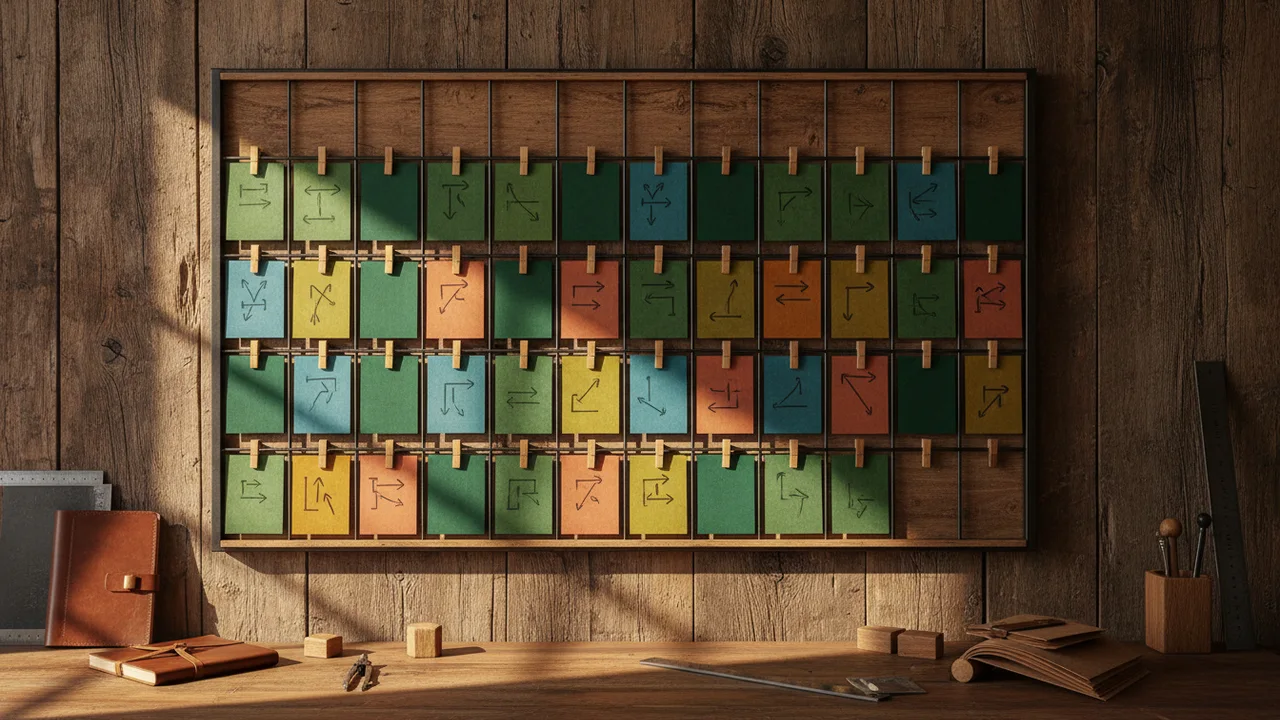
Agile project management is an iterative approach that builds products in short cycles, and the 2001 Agile Manifesto set its four core values. Instead of one long plan, teams ship small increments, gather feedback, and adjust. The Project Management Institute reports 71% of organizations now use agile. It runs through repeated loops of plan, build, and review, so priorities can change without wrecking the whole project.
What is agile project management?
Agile project management is a way of running projects in short, repeating cycles rather than one fixed timeline. Work is broken into small increments that ship, get feedback, and shape the next cycle.
The approach traces back to the Agile Manifesto, published in 2001 by the Agile Alliance, which prioritizes individuals and interactions, working software, customer collaboration, and responding to change. IBM's Agile Transformation Guide describes it as iterative and incremental development — cycles of planning, execution, and review. The goal is simple: reduce the cost of being wrong. If a feature misses, you learn it in two weeks, not two quarters.
How does agile project management work?
Agile works by splitting a project into short cycles called iterations or sprints, usually one to four weeks. Each cycle runs the same loop: plan the highest-priority work, build it, review it with stakeholders, then adjust.
A typical flow looks like this:
You might also like
- Build a backlog — a ranked list of work, most valuable at the top.
- Plan a sprint — pull the top items the team can finish in the cycle.
- Hold short daily check-ins to surface blockers fast.
- Ship a working increment at the end of the sprint.
- Review with stakeholders and run a retrospective to improve the next cycle.
Because priorities are re-ranked every cycle, change is expected, not punished. The Standish Group's 2020 CHAOS Report found agile projects succeed 39% of the time versus 11% for traditional waterfall projects.
How is agile different from traditional project management?
Agile differs from traditional (waterfall) management in when decisions get made. Waterfall locks scope up front; agile keeps scope negotiable and ships continuously.
| Dimension | Traditional (waterfall) | Agile |
|---|---|---|
| Planning | One big plan up front | Re-planned every cycle |
| Delivery | One release at the end | Working increment each sprint |
| Change | Costly, resisted | Expected, welcomed |
| Feedback | Late, after launch | Every 1–4 weeks |
| Success rate | 11% | 39% |
The success-rate figures come from the Standish Group's 2020 CHAOS Report. The pattern is consistent: shorter feedback loops catch mistakes earlier, when they are cheap to fix.
Which agile frameworks should you know?
The frameworks worth knowing are Scrum, Kanban, and Lean. Scrum is the most common — the Scrum Alliance reports 66% of agile teams use it.
- Scrum — fixed-length sprints, defined roles, and ceremonies like planning and retrospectives. Best for teams that want structure.
- Kanban — a continuous flow board with work-in-progress limits and no fixed sprints. Best for support and steady request streams.
- Lean — focuses on cutting waste and maximizing value; the source of much agile thinking.
Teams often mix them. Books like Scrum by Jeff Sutherland and Making Work Visible by Dominica DeGrandis are practical starting points. Most teams run these on tools — Atlassian's Jira Guide covers Jira, while Asana and Trello are common alternatives.
How we run agile shipping software every day
We run agile at Botensten because renting a rigid plan is how solo operators drown. We build production features in one- to two-week cycles, ship on a public timeline, and re-rank the backlog every Monday. Here is what actually happens, not the textbook version.
Our sprints are short on purpose. A two-week cycle means the worst case for a wrong bet is two weeks of work, not a quarter. Last cycle we scoped a full analytics dashboard, shipped the single chart users asked about first, and cut the rest. The extra columns nobody needed never got built. That is agile doing its real job: protecting your time.
What broke for us early was ceremony overload. As a small team we ran daily standups, planning, retros, and reviews, then spent more time talking about work than doing it. We cut it to a Monday plan and a Friday review, kept the backlog ranked, and shipped faster. Agile is a set of tools, not a religion. Keep the parts that reduce the cost of being wrong; drop the rest. Shape Up's fixed-time, variable-scope betting fits a small shop better than heavyweight Scrum.
What are the benefits and risks of agile?
The main benefit of agile is faster, cheaper learning — you find out what works in weeks. VersionOne's 2020 State of Agile report found 85% of organizations saw improved team productivity after adopting it.
Benefits in practice:
- Change is cheap because scope is re-decided each cycle.
- Working software ships continuously, so value arrives early.
- Short feedback loops catch mistakes while they are small.
The risks are real too. Without a ranked backlog, agile becomes aimless busywork. Without a clear product owner, priorities thrash. And "agile" is often used as an excuse to skip planning entirely, which it never was. Stack Overflow's 2020 Developer Survey found 87% of developers use agile, so the ideas are everywhere; doing them well is the hard part.
0 Comments
Log in to comment
Not a member yet? Join the community
Pick a meme
KlipyHave a great take?
Drop your email — we'll send a magic link so you can post it. No password.
Not a member of the community? Join today.
Join the community →